Difference Between IUI and IVF: Which Fertility Treatment Is Right for You?
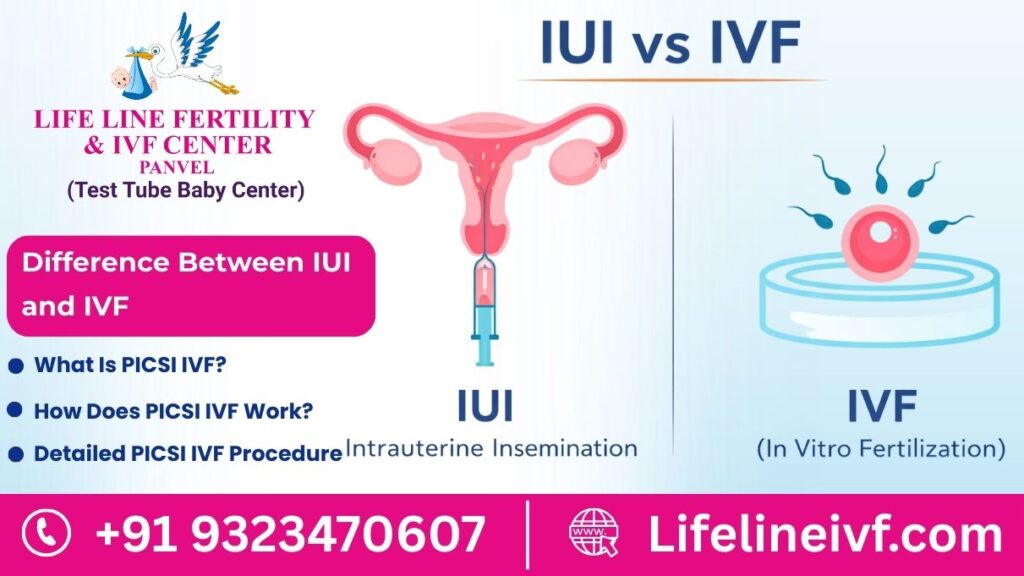
Blog Difference Between IUI and IVF: Which Fertility Treatment Is Right for You? IUI and IVF are two popular fertility therapies that couples who are having trouble becoming pregnant frequently learn about. This raises an often asked question: What distinguishes IUI from IVF, and which is superior? In terms of process, success rates, expense, and medical involvement, both therapies assist couples in becoming pregnant, although they differ greatly. Age, fertility issues, and medical history all play a role in selecting the best option. Anyone may readily comprehend the differences between IUI and IVF thanks to this blog’s clear, step-by-step explanation in straightforward language. Understanding the Basics of Fertility Treatments It’s critical to comprehend the true meanings of IUI and IVF before comparing the two therapies. What Is IUI? Intrauterine insemination is referred to as IUI. During ovulation, healthy sperm are inserted straight into the woman’s uterus as part of this fertility procedure. IUI aims to: Make it easier for sperm to reach the egg Boost the likelihood of fertilisation IUI is regarded as a straightforward and less intrusive kind of reproductive treatment. What Is IVF? In vitro fertilisation is referred to as IVF. This procedure involves taking the woman’s eggs and fertilising them with sperm in a lab. After that, the embryo is placed inside the uterus. IVF is a more sophisticated fertility treatment that is typically advised when other approaches are unsuccessful. What Is IUI (Intrauterine Insemination)? For couples with minor infertility issues, IUI is frequently recommended as the initial reproductive treatment. How Does IUI Work? The IUI procedure consists of: Observing ovulation Gathering and cleaning sperm Directly inserting sperm into the uterus The process is fast and typically painless. Who Is IUI Best Suited For? IUI is typically advised for: Mild infertility in men Inexplicable infertility Issues with cervical mucus Couples making a brief attempt Younger women who ovulate regularly benefit most from it. Success Rate of IUI Age and reproductive status have an impact on IUI success rates. 10–20% of cycles are successful on average. Greater achievement among women under 35 It might take several cycles. What Is IVF (In Vitro Fertilization)? IVF is a more advanced and controlled fertility treatment. How Does IVF Work Step by Step? IVF involves: Ovarian stimulation with medications Egg retrieval Fertilization in a lab Embryo development Embryo transfer into the uterus Each step is carefully monitored by fertility specialists. Who Is IVF Best Suited For? IVF is recommended for: Blocked fallopian tubes Severe male infertility Endometriosis Advanced maternal age Repeated IUI failure Worried About IVF Pain? Talk to Our Fertility Experts and Get Clear Guidance Today Book An Appointment Success Rate of IVF IVF generally has higher success rates than IUI. On average: 40–60% success per cycle (age-dependent) Higher success with good embryo quality What Are the Key Differences Between IUI and IVF? Understanding the difference between IUI and IVF helps couples make informed decisions. Difference in Procedure IUI: Sperm placed inside the uterus IVF: Fertilization happens outside the body Difference in Success Rates IUI: Lower success per cycle IVF: Higher success per cycle Difference in Cost IUI: Less expensive IVF: More costly due to advanced technology Difference in Time and Complexity IUI: Simple and quick IVF: Longer and more complex Difference in Medical Intervention IUI: Minimal medication IVF: Hormonal stimulation and procedures The Differences Between IUI and IVF at a Glance This section is ideal for a comparison table. IUI vs IVF – Treatment Comparison Summary IUI is simple, affordable, and less invasive IVF is advanced, controlled, and has higher success IUI is usually tried before IVF When to Choose IUI vs IVF? Choosing between IUI and IVF depends on medical factors. When Is IUI the Right Choice? Choose IUI if: You are under 35 Fertility issues are mild This is your first fertility treatment When Is IVF the Better Option? Choose IVF if: IUI has failed multiple times Fallopian tubes are blocked Male infertility is severe Woman’s age is above 35 IUI vs IVF: Which Is Better for You? There is no single “best” treatment for everyone. Why Choose Lifeline IVF Hospital? Lifeline IVF Hospital focuses on patient comfort, safety, and emotional care throughout the IVF journey. The hospital offers experienced fertility specialists, modern IVF technology, and gentle treatment protocols to minimize pain and stress. Each patient receives personalized care, clear explanations, and continuous support, making IVF treatment as comfortable and reassuring as possible. Conclusion So, is IVF painful? For most women, IVF is not very painful. With modern medical techniques, anesthesia, and expert care, discomfort is kept minimal. Understanding each step of IVF helps reduce fear and anxiety. With compassionate care and advanced treatment at Lifeline IVF Hospital, IVF becomes a safe, comfortable, and hopeful journey toward parenthood. FAQs Is IVF more painful than natural pregnancy? No. IVF pain is temporary and mild, while pregnancy discomfort lasts longer. Can IVF be done without pain? Most IVF procedures are painless or cause very little discomfort. How long does IVF pain last? Mild discomfort usually lasts only a few days. Does IVF pain affect success rates? No. Pain does not affect IVF success. No. IVF pain is temporary and mild, while pregnancy discomfort lasts longer. Most IVF procedures are painless or cause very little discomfort. Mild discomfort usually lasts only a few days. No. Pain does not affect IVF success. Take the First Step Toward a Comfortable IVF Journey Worried About IVF Pain? Talk to Our Fertility Experts and Get Clear Guidance Today Book An Appointment