
How Is Surrogacy Done? IVF Process & Legal Guide India

Blog How Is Surrogacy Done? Process, Legal Rules and Fertility Treatment in India For many couples, having a baby is one of the biggest dreams in life. However, some couples face medical problems that make pregnancy difficult or impossible. In such situations, surrogacy can offer hope. Surrogacy is a medical process where another woman carries a baby for the intended parents. Many people often ask How Is Surrogacy Done and what steps are involved in the process. With modern fertility treatments like IVF (In Vitro Fertilization) and expert medical care, surrogacy has become a reliable option for couples struggling with infertility. Fertility centers such as Lifeline IVF provide advanced reproductive treatments and expert guidance to help couples understand and navigate the surrogacy journey safely. What Is Surrogacy? Meaning of Surrogacy Surrogacy is a fertility treatment in which a woman, called a surrogate mother, carries and delivers a baby for another couple who cannot carry a pregnancy themselves. The couple who wants the baby are known as the intended parents. In most modern cases, surrogacy is done through IVF treatment, where an embryo created using the parents’ egg and sperm is placed into the surrogate mother’s uterus. Why Some Couples Choose Surrogacy Couples may consider surrogacy for many reasons. Sometimes the woman may not be able to carry a pregnancy safely due to medical conditions. In other cases, repeated IVF failures or miscarriages may make surrogacy the best option. How Surrogacy Helps Couples With Infertility Infertility can be emotionally challenging for couples. Surrogacy gives hope by allowing another healthy woman to carry the baby while the intended parents remain involved in the pregnancy journey. Who May Need Surrogacy? Women Who Cannot Carry a Pregnancy Some women are born without a uterus, while others may have had their uterus removed due to surgery or health problems. In such cases, pregnancy cannot happen naturally. Medical Conditions That Affect Pregnancy Certain health conditions such as heart disease, severe diabetes, or repeated pregnancy complications may make pregnancy unsafe for the mother. Fertility Problems in Couples Couples who experience repeated IVF failures or multiple miscarriages may also consider surrogacy as an option. How Is Surrogacy Done? Step-by-Step Process Medical Consultation and Fertility Tests The process usually begins with a consultation at a fertility clinic. Doctors evaluate the health of the intended parents through various medical tests such as hormone tests, ultrasound scans, and semen analysis. Choosing a Surrogate Mother A surrogate mother must be physically and emotionally healthy. She undergoes medical and psychological screening before being selected. IVF Procedure and Embryo Creation Doctors collect eggs from the intended mother and fertilize them with the father’s sperm in a laboratory. This creates embryos through IVF treatment. Struggling with Male Infertility or Failed IVF? Explore PICSI IVF for Better Success Book An Appointment Embryo Transfer and Pregnancy Care A healthy embryo is placed into the surrogate mother’s uterus. If implantation occurs successfully, pregnancy begins and doctors monitor the pregnancy regularly. Birth of the Baby and Legal Formalities After about nine months, the surrogate mother gives birth to the baby. Legal procedures are completed so that the intended parents become the official parents. Types of Surrogacy Gestational Surrogacy Gestational surrogacy is the most common type used today. In this method, the surrogate mother carries an embryo created through IVF using the intended parents’ egg and sperm. Traditional Surrogacy In traditional surrogacy, the surrogate mother’s egg is used to create the pregnancy. This method is less common today. Which Type of Surrogacy Is Allowed in India Under Indian regulations, gestational surrogacy is the legally accepted form. Surrogacy Laws in India Surrogacy Regulation Act Overview The Surrogacy Regulation Act helps ensure that surrogacy practices are ethical and safe for everyone involved. Eligibility Criteria for Intended Parents The law specifies eligibility conditions for couples seeking surrogacy, including medical proof of infertility. Legal Requirements for Surrogate Mothers Surrogate mothers must meet certain medical and legal requirements and provide voluntary consent. Role of Male Fertility Specialists in Surrogacy Importance of Healthy Sperm in IVF Healthy sperm plays an important role in creating strong embryos during IVF treatment. Male Fertility Testing and Diagnosis Tests such as semen analysis help doctors evaluate sperm count, movement, and quality. How Specialists Improve Fertility Outcomes Specialists may recommend treatments or advanced techniques like ICSI to improve fertilization success. Why Choose Lifeline IVF Choosing the right fertility center can make an important difference in the journey toward parenthood. Lifeline IVF offers advanced fertility treatments supported by experienced specialists and skilled embryologists who have extensive expertise in assisted reproductive technologies. The clinic uses modern laboratory equipment and advanced medical techniques to support fertilization and embryo development. At the same time, the focus remains on personalized care, recognizing that every couple’s fertility journey is unique. Each patient receives an individualized treatment plan designed according to their medical condition, fertility goals, and overall health, ensuring compassionate and supportive care throughout the treatment process. Conclusion Surrogacy has become an important option for couples who cannot conceive naturally. Understanding How Is Surrogacy Done helps intended parents make informed decisions about their fertility journey. With advanced medical technology, expert fertility specialists, and proper legal guidance, surrogacy can provide a safe and effective path to parenthood. Frequently Asked Questions (FAQs) How is surrogacy done step by step? Surrogacy usually involves medical consultation, fertility testing, selecting a surrogate mother, IVF embryo creation, embryo transfer, pregnancy monitoring, and the birth of the baby. Is surrogacy legal in India? Yes, surrogacy is legal in India under the Surrogacy Regulation Act, which ensures ethical and regulated practices. How long does the surrogacy process take? The process may take several months for preparation and about nine months for pregnancy. What medical tests are required before surrogacy? Common tests include hormone tests, ultrasound scans, genetic screening, and semen analysis. Surrogacy usually involves medical consultation, fertility testing, selecting a surrogate mother, IVF embryo creation, embryo transfer, pregnancy monitoring, and the birth of the baby. Yes, surrogacy is legal in India under the Surrogacy
MESA Full Form: Meaning, Procedure and Role in IVF Treatment
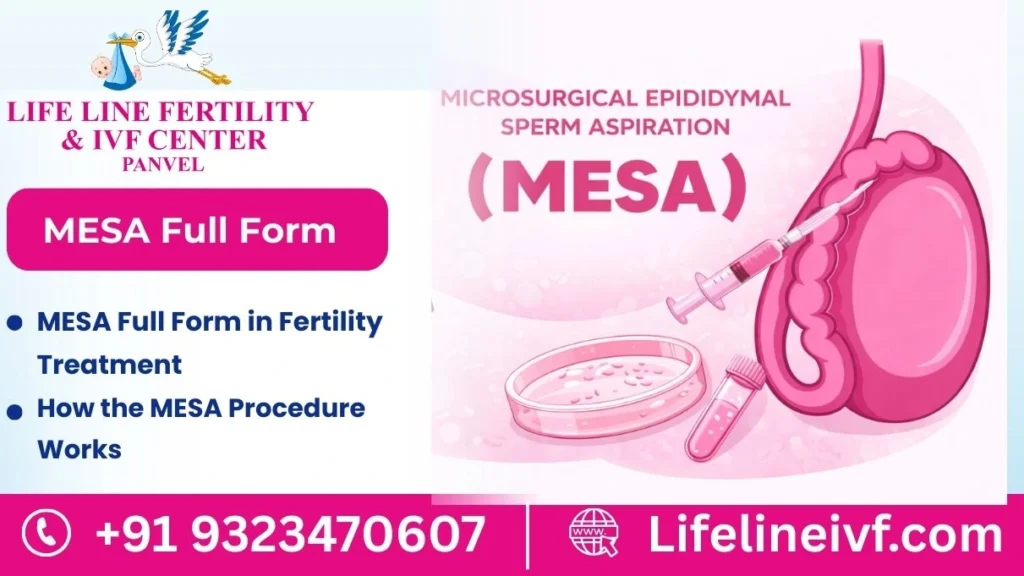
Blog MESA Full Form: Understanding Microsurgical Epididymal Sperm Aspiration in Fertility Treatment Many couples imagine having a child someday. For most people it happens naturally, but sometimes it doesn’t go as planned. Fertility problems are actually more common than people think, and in quite a few cases the issue may be related to sperm. Now, when sperm cannot come out naturally in semen, doctors may suggest special medical procedures to help retrieve sperm directly from the male reproductive system. One such procedure is called MESA. A lot of people search online for the MESA full form because the term sounds complicated at first. But once you understand what it means and how it works, it actually becomes much easier to grasp. The MESA full form is Microsurgical Epididymal Sperm Aspiration. It’s basically a medical procedure that helps doctors collect sperm directly from a small tube behind the testicles called the epididymis. This tube stores sperm after they are produced in the body. The sperm collected through the MESA procedure can then be used in fertility treatments like IVF or ICSI, which help fertilize the egg in a laboratory setting. For many couples facing male infertility, this procedure has helped make pregnancy possible. Understanding the MESA full form and its role in fertility treatment can really help couples feel more informed and a little less anxious when exploring their options. MESA Full Form in Fertility Treatment So first things first- the MESA full form stands for Microsurgical Epididymal Sperm Aspiration. It might sound like a big medical phrase, but the idea behind it is quite simple. The procedure allows doctors to collect sperm directly from the epididymis, which is a tiny tube located behind the testicles where sperm mature and are stored. In some men, sperm are produced normally in the testicles, but they cannot travel out through the reproductive tract. This usually happens because of a blockage or missing tubes that carry sperm. So even though the body is producing sperm, it never shows up in the semen. This is where the MESA procedure becomes useful. During the procedure, doctors use a microscope and very delicate surgical tools to carefully retrieve sperm from the epididymis. Once the sperm are collected, they can be used in assisted fertility treatments like IVF or ICSI. In many cases, these treatments help the sperm fertilize the egg and start embryo development. For couples dealing with male infertility, understanding the MESA full form and procedure can be an important step in exploring possible treatment options. Why Is the MESA Procedure Used in Fertility Treatments? The MESA procedure is usually recommended when sperm cannot be found in semen even though sperm production in the testicles is normal. Normally, sperm travel from the testicles through small tubes called the vas deferens and eventually leave the body during ejaculation. But if these tubes are blocked or missing, sperm cannot reach the semen. That means even though sperm are present in the body, they simply can’t get out naturally. In such situations, fertility specialists may use MESA as a sperm retrieval technique. By collecting sperm directly from the epididymis, doctors can still obtain healthy sperm for fertility treatments. These sperm are then commonly used in ICSI, where a single sperm is injected directly into an egg. This helps fertilization happen even if only a small number of sperm are available. For many couples, this approach opens up a chance of pregnancy that might otherwise not be possible. Who May Need the MESA Procedure? Not everyone experiencing infertility needs the MESA procedure. It is mainly recommended for certain types of male fertility problems. Obstructive Azoospermia One of the most common reasons for the MESA procedure is a condition called obstructive azoospermia. In this condition, the testicles produce sperm normally, but sperm cannot travel through the reproductive tract due to a blockage. This blockage might be caused by infection, injury, previous surgery, or sometimes a genetic condition. With MESA, doctors can bypass the blockage and retrieve sperm directly from the epididymis. Previous Vasectomy Some men have had a vasectomy earlier in life but later decide they want to have children. In cases where vasectomy reversal is not possible or successful, the MESA procedure may be used to retrieve sperm for IVF or ICSI treatment. Congenital Absence of the Vas Deferens In rare cases, some men are born without the tubes that carry sperm from the testicles. This condition is called congenital absence of the vas deferens. Even though sperm production is normal, sperm cannot leave the body naturally. MESA helps retrieve those sperm so they can be used in fertility treatments. When Do Doctors Recommend MESA? The MESA procedure is usually performed by experienced fertility specialists using microsurgical techniques. Step 1: Anesthesia The patient is usually given anesthesia so that the procedure is comfortable and pain-free. Step 2: Accessing the Epididymis Using a surgical microscope, the doctor carefully locates the epididymis, where mature sperm are stored. Step 3: Retrieving the Sperm A small amount of fluid containing sperm is gently collected from the epididymis. Struggling with Male Infertility or Failed IVF? Explore PICSI IVF for Better Success Book An Appointment Step 4: Lab Examination The collected fluid is then examined by embryologists in the fertility laboratory. The sperm are prepared so they can be used in IVF or ICSI treatments. How MESA Works With IVF and ICSI The MESA procedure itself does not directly lead to pregnancy. Instead, it provides sperm that can be used in assisted reproductive treatments. Most commonly, the retrieved sperm are used in ICSI, where a single sperm is injected into an egg. This method helps fertilization occur even when sperm numbers are low. After fertilization happens in the laboratory, the embryo begins to grow for a few days. Then doctors transfer the embryo into the uterus, hoping it will implant and develop into a pregnancy. Benefits of the MESA Procedure For many couples dealing with male infertility, the MESA procedure offers several advantages. Reliable Sperm